Politics in Commander: Don't Trade Life For Sand
Or: 'The Technique Of The Agreement'
John Labelle
Edited by Sanne te Riele
He traded sand for skins, skins for gold, gold for life. In the end, he traded life for sand.
"If I take the counters, are you going to attack me?"
I'm sitting down for what must be my eighth or ninth game of the day at MagicCon Amsterdam. Voja is doing what Voja does best: smashing Elves and Wolves together in a depraved multi-species orgy of value. Be'lakor the Dark Master sits to his left, badly crippled by my Bear and his questionably acquired peerage.
Be'lakor rocketed out ahead at the start, opening with Sol Ring into Arcane Signet. In modern parlance we call this a "Bracket 3 deck", meaning my opponent merely has five mana to my one. It doesn't take him long to turn Player FourRIP Player Four: "All I remember about you is that you died." into exotic new propellants. Wilson is big, but I am dead in the water: I can kill Be'lakor, but I will be immediately attacked by Voja for approximately 999 damage when he untaps. My attacks on Voja are bad (his commander is too big) and they are only going to get worse. There is not much for me to do here but untap, draw a card, and hang on for dear life. But then Voja, foot on my neck, comes for a deal.
"If I take the counters, are you going to attack me?" Voja asks. I glance at the board state, hiding my disbelief. Wilson is an 8/8, Voja is 15/15 and his entourage of mana elves is not far behind. If he takes Wilson's counters, he cannot attack me (absent a Questing Beast)He can attack me, but not productively.. I am getting an extra turn alive for reasons I do not understand. "No," I answer, letting him take the counters and drawing a card. The path to victory is hard to see—my opponent's board has too many creatures, his hand is too full of gas. I watch with feigned disinterest as he jams Akroma's Will and tramples Be'lakor to death, gaining ~50 life off the lifelink. This, at least, is fine—as far as I'm concerned, his life total is still 21.
An extra turn is a long time, as my opponent discovers: I cast Return of the Wildspeaker and rip The One Ring, which will keep me alive long enough to cast the other nine cards I drew. I try for Galadriel's Dismissal in his next attack step, and he responds with an ill-timed Teferi's Protection. I Reprieve my Galadriel's back to my hand, let him have the turn of protection, then phase out his entire menagerie and kill him with Wilson one turn later.
Later on that day I cast The One Ring directly into Collector Ouphe, so please do not get the impression I think my opponent was a bad player. It's difficult to play precisely against three unknown decks, especially after doing so all weekend at a big loud conventionIt is also surprisingly difficult to play precise Magic when you have a lot of resources and no way to combo out. It is too easy to draw fifty cards and feel your brain buckle under the weight of its options.. And his mistake could very well have been correct play: if I could kill him on the crackback through precise application of double strike and Seasoned Dungeoneer, it would have been lethal for him to pass on a dealWhich did happen to a Jodah player the next day..
Ultimately, I think his mistake was instructive, but not unusual: He made a Bad Deal, which gave me an undeserved chance to get back into the game. I took it and won. I see commander players make Bad Deals all the time; they are a terrific way to give your opponent a humongous edge for zero mana. All too frequently, I make them myself: I think I have negotiated a safe way out of a tough situation, then die with my pants around my ankles a turn or two laterMetaphorically..
Many players when presented with Politics will recoil in instinctive fear, like a Gruul player seeing a card with more than two lines of rules text. Two-player Magic asks us to do only one thing: make the best play to win the game. But the interplay of four players and their wretched idiosyncrasies makes things harder. It asks us to think: How do I make a deal? How do I intelligently cooperate in a game where I am trying to win? How can I do so in a social setting where the other players and I are doing our best with the scant mirror neurons God gave us? A social setting where participants must be reminded sometimes to bathe themselves?
These questions deserve scrutiny. Making good deals is part of being a good player, and as a bonus good dealmaking in Magic can teach us facts about the world around us. I will explain my theory of good dealmaking, and show you how to make it your own, but there is another, more important type of deal to discuss firstA special shout-out to Sidereal Confluence, an absolutely mind-bending game that lets you make mind-bending deals. This article never would have come to be without it. .
Bad Deals
Never interfere with the enemy when he is in the process of destroying himself.
Your opponent has four cards in hand, eight mana, and is looking between his life total (7) and your commander (an 8/8). He has a great offer for you: "If you don't attack me this turn, I won't remove your creature." There are a range of explanations for this offer, with two fundamental axes:
- Your opponent wants you to have a long and loving relationship with your 8/8. They are hoping that you release an album full of banjo duets on vinyl. It would cause them nothing but great sorrow to use their removal on your creature, since they would never get to hear your sweet licksYour opponents will never actually draw attention to the reason they want to make this deal, but whatever explanation they could give is almost equally absurd..
- Your opponent wants to draw fifteen cards and cast sixteen cards. They are worried that you will kill them before they do this, because you are a jerk who never lets anyone have fun. They don't even have a removal spell in hand; they may never have cast Swords to Plowshares in their entire life.
This deal is very bad, but it gets made in commander a lot. Why does this work? Your opponent has information about cards in their hand, and you don't. They hope you don't think about this fact too carefully and are just happy to keep your stuff. They are also hoping that you forget about this hypothetical removal, and that they can still use it later. Attacking and killing them before they untap cuts them off their fifteen cards, and is a much better path to victory for you. Your opponent is gracious enough to stop you before you try to walk it.
The player on the other side of your deal knows something that you don't (they are holding Biomantic Mastery) and is going to use this against you (by letting you keep a creature that is not going to help you in Hell). This phenomenon is known as adverse selection, and it is the vile scaffolding of many pit traps in CommanderAnd in real life, which is a theme we will see a lot here.. It gives us the first type of bad deal in Magic: a bad deal is one that your opponent is offering.
Does this mean that you should never accept deals your opponents propose? Unfortunately, you are someone's opponent; if you decide that you can never agree to an opponent's offer, then your opponents should never do so either. You will be stuck releasing solo kazoo albums because all your creatures will die before combat. So you can't automatically reject what your opponent proposes, but you can and should think about it:
- Why now? Your opponent could have made this deal earlier, or later, but he is thinking about it nowThe two most common times are usually during their own main phase or at the start of combat.. Is this time good for you, or just the time your opponent offered you a deal? What changed to make this deal appealing to them?
- What do you lose from this deal? In this situation, what you get is 'your creature gets to stay alive', which is tempting. But your opponent knows this creature is good, and wants to let you keep it anyway. Why is that so valuable to them?
- What do you know that your opponent doesn't? Your opponent may have a secret plan, but you can have secret plans too. You may have them dead to rights with an Orim's Chant and plan to attack someone else this turn anyway. You may have your own insidious plans to make them read Kaervek's Torch when you cast it for X=400 during your second main phase. Their deal may seem good for them, but be even better for you.
Your opponents will offer you a lot of things, but the thing they usually want is time. You have an aggressive board state, and your opponent needs to cut a deal with you because they want to cast good spells without dying. Letting them do so lets them spend time operating their carnival of value. This is another classic bad deal: Your opponent wants to make a deal to get pressure off them so they can develop their engine.
In an earlier article, I talk about three factors that dictate strategy in Commander:
- Engine: Your deck 'doing its thing'. You use cards to convert mana into more mana, and use mana to convert cards into more cards.
- Pressure: Your deck tries to kill or hinder someone, which turns their attention and resources away from powering up their engine and towards not getting killedIt also forces them to make high stakes decisions correctly or lose, which is powerful for a variety of reasons..
- Flow: Your deck tries to redirect pressure to other opponents, by playing blockers, using cards like Propaganda, and slow-rolling your giant threats.
All of these factors are important, and all decks end up developing as the game goes on. But they are not treated with the same respect! It only takes a few games of Commander to notice that having an engine is good. If you spend a lot of time trying to kill your opponents through combat, or getting killed in combat, then pressure is constantly on your mind. But flow is the most subtle of the three: we must ask ourselves "How do I get my pressure to the right place? How do I get my opponent's pressure to the right place? How do I make sure that the right place is not my soft, chewy skeleton?"
One way that should never work is simply asking your opponents not to attack you. "I'm just a little guy." you might say. "Just a teeny fella. No need to remove my Doubling Season." Endless, endless intimations of "This is actually my first game of Magic. The mayor is coming afterwards to hand me a big balloon for being a special boy." These protests are asking them to make a more subtle bad deal: Please don't make me put blockers in my deck. Don't make me interact on the axis that your deck is designed to interact on. I won't remove your stuff, or wipe the board, or do anything to interfere, and you won't do anything to interfere with me.
I don't hold players who shy away from aggressive strategies in any particular contempt. This desire to relax and let the game unfold is a kind impulse: some players love to see what new surprises their opponents have for them, dazzled by the show even as they perish. These players often feel bad for attacking, rolling a die to decide who to hit with their 10/10. It can feel bad to hit someone who's not really up to anything, and it feels bad for some players to be attacked for 8 just because you want to put a Cool Dinosaur in your Cool Dinosaur Deck.
But I have free-flowing disrespect for a different type of player: the Value Player Who Just Wants To Have Fun. It's coming up to my attack step, and this player Just Wants To Play The Game. She is just playing her Sweet Superfriends Deck, and I rudely want to use my Sword of Fire and Ice to kill her Bloom Tender. If I just do her the favor of shocking someone else, she won't wipe the board and my pumpkin-headed idiot gets to liveYes, I have updated my tooltip library to be able to have arbitrary text. I am excited about it.. Why won't I just let her Play The Game?
This is the same bad deal as we saw before, but we get to see how bad it is with another lens. Our opponent's commander is a great blocker that also happens to be a solid value engine and a good attacker. It's early enough that her engine is not yet vomiting out counters; as the game goes on, this balance of power is going to shift. I have a lot of swords and I can get a lot of them on my commander very quickly. But eventually the probability of my commander being a 3/3 Elk with seventeen stun counters is going to approach one. Pressuring her is my only reasonable strategy; ignoring a player whose engine scales better than others may let me keep my commander alive now, but it is a losing idea.
If your opponent asks you to not remove their engine pieces or attack them, you need to think hard about what you get in return. Your opponent gets a turn to tap out for big spells and also has time to prepare for your subsequent offence. If you make this deal during their turn, you may be giving them two full turn cycles without your creatures howling at the gates. Are you confident you can get an attack in two turns from now?
If she instead spends cards and mana defending herself, that is time she isn't spending developing her engineAnd if they have to put those blockers and interaction in their deck, that's fewer explosive draws for you to be unable to race. More where the outcome of the game is not a bygone conclusion.. Maybe she does remove your commander, but at least the other crabs in your bucket can spend their resources dragging her down before her deck outscales yours. If she is asking for the deal now, it's usually because she doesn't think she will be as afraid of you later. The resources that she has to interact with you are not going anywhere; you need to decide if you have a plan for that. Maybe you have Blacksmith's Skill, but are tapped out; in this case the extra time is more valuable to you than it is to her.
These deals that boil down to "You pressure me less, and in exchange I don't have to do anything to react to that pressure" are usually bad. Seeing where pressure needs to go is one of the most difficult parts of the game for new players: it requires an understanding of where the game is going to be in a few turns, as well as seeing which opponents are doing things that are most dangerous to you specifically. But your opponent asking you not to hit them in the face is very often a clue you should be reaching for your face-sized hammer.
This is the essence of a related bad deal: Making a deal with the player who is already winning the game. Sometimes it is clear that one player is ahead of the others in cards and mana, and sometimes you have the opportunity to cripple or kill them before they can pull away in a cloud of undead miasma. Decks that are spiraling out of control with value often lack defense, and decks that can apply a lot of pressure are sometimes missing the resources to kill each player in succession. A player in either position may come to you for a deal, and they will rarely help you win.
There are other species of Bad Deal that pop up, and all of them are similar in one way: they make you more likely to lose the game. It sounds tautological, but every bad deal boils down to the same thing: your opponent misleads you into thinking that a deal makes you more likely to win, even though it does not. 'Mislead' can be explicit ("if you don't attack me I'm not going to win next turn [but I will wipe the board]") or implicit ("If you don't attack me I won't remove your creature[which will result in a board state where I am much more likely to win]"). You agree, thinking you are now more likely to prevail, and are demolished when your opponent yanks the football awayThis is a reference to a 'comic strip', which is a sort of short manga popular with the elderly..
It is not always one player intentionally bamboozling another; players sometimes make deals that seal their own fate. Younger players frequently step on this rake: they see their deck doing its thing, and make a deal to try to maintain this state of affairs. "I won't attack you if you don't remove my creature." They sometimes misread flow entirely: A new player fears the worstTaking 8 damage and comes begging for peace just as the more experienced player moves to combat. They agree to not use removal on a creature that was not going to attack them anyway, and inadvertently reveal the presence of that removal to everyone else at the table.
We will return to the ethics of this situation later. But now that we have covered the bad deals, we can understand the good ones.
Good Deals
It’s a win-win arrangement. I just happen to win the most.
Bad Deals come in many forms, but they are all the same monster, a thousand masks all hiding the same face. Good Deals are simply the other side of the coin. There is only one Good Deal: You make a deal with one player to take win rate percentage from the other playersOkay, you could technically do this with two or more opponents to take it from another player. Three players ganging up on a fourth is common; making deals to do so is quite rare..
This really is the only good deal. The game's outcome is always uncertain, and some players are favored over others. You and your opponents all want to be more favored to win, but this 'win rate percentage'It's not possible to calculate, but hopefully you can accept that 1)victory is never certain and 2)some plays make it more likely. (WR% or sometimes WR) is only going to go up for you if it goes down for someone else. Thus, if your counterparty only accepts deals that make them more likely to win, that is going to come at the expense of someone else. Let's look at a concrete example:
- Me (Wilson), You (Karlov) and Todd Temur (Maelstrom Wanderer) are all wounded but alive after the tragic death of Player 4RIP Player 4: "She wasn't very useful for my pedagogical example.". It's my turn, and I examine the board state. Maelstrom Wanderer is in Todd's very full hand, and he controls twelve lands along with a Doors of Durin. He tried to play a Veil of Summer earlier into an on-board Voice of Victory, so we know his hand still has that. If he untaps, a lot of creatures are probably going to hit the board very fast, and any countermagic probably means the end of our short, brutish lives.
- So things are looking bad for life on Earth—you estimate a 10%/5%/85% chance to win for me, you, and Todd respectively.
- However... I can probably turn him into bear chow before he turns us into slag. He has three untapped mana, but my deck is pretty good at forcing its commander through. You don't know what cards I have, but any combination of Reprieve, Ram Through, and Duelist's Heritage will do it.
- This attack is not good for me, though—your Karlov has ten +1/+1 counters. If I spend my turn forcing lethal damage through interaction and countermagic, you might kill meI took some damage from Karlov earlier, but Todd didn't.. Removing my commander or giving Karlov evasion will seal my fate.
- Therefore, you propose a deal: I spend my turn killing Todd (or at least trying to), and in exchange you don't attack me next turn.
Should I take this deal? If Todd is dead, my WR% will increase: his WR goes from 85% to 0%, but the win rate for us still adds up to 100%. Karlov is built-in removal for Wilson, which is good for you, but it makes him smaller, which is good for me. Combat-blowouts like Wing Shards could be on either side. So the outcome is uncertain: we both have huge creatures on board and cards in hand. But maybe you think the game is close to a coin flip (60%/40% in my favor). You are still not favored to win, but your route to victory is a lot more plausible. We take Todd's WR% and divide it between us.
Sometimes a deal feels worse than this, but the reasoning is the same. Say I control Nine-Fingers Keene with 5 gates, including Basilisk Gate. Annette is playing Teysa Karlov with a mess of tokens. Her position is not as overwhelming as last game, but pressuring her is proving difficult and she is spinning backstories for each 1/1 spirit she creates. We do not want to hear of another spirit whose backstory is oddly similar to John Wick's. Annette's cretinous brother Ted is playing Fynn the Fangbearer and has missed four land drops, complaining that he got punished for keeping a one-lander"I just needed to draw a land three turns in a row." Ted complains. "My deck still has twenty-five left, so the odds are good.". I'm 25% WR, you're 25%, Annette is 35%, and Ted is down in the toilet at 15%Things are closer because it's earlier in the game. Ted's WR% is surprisingly high: I also find players who miss land drops win a lot simply from never being pressured..
I need Gates, and that means hitting someone with Keene. I can't attack Ted- he will trade his only two creatures for my commander due to his suspect craniometrics. Annette has a bunch of 1/1s and I have no trample. We both benefit from a deal:
- I can activate Basilisk Gate targeting Keene to make her a 9/9, then attack you. You'll throw two creatures in the way to stop the damage, or take nine to the face- both of these options are pretty bad for you.
- They're not great for me either. I would like to spend that mana on other things. I want you on the table since you're going to help me stop Annette. You probably want me to spend my mana on things to make her life worse too. And if you have nine points of commander damage, you really want Keene dead, ward cost or no.
- So I'll make you a deal: I'll hit you with Keene and you won't block, taking four instead of nine.
Should you take this deal? Maybe. If you think I can use that three mana to pressure Annette, that's good for you—both of us benefit from her life being worse. And I'm going to attack you one way or another—minimizing the damage from that is helpful to both of us. We probably pick up 2-3% WR from this deal, mostly at the expense of Annette and probably a little at the expense of Ted. Both of us get something we want.
Something in your brain probably seethes at this deal, since it's less a mutual agreement and more rank extortion. "That's a nice life total... shame if something were to happen to it". But if we both come out ahead on this deal, it's worth it mathematically. I'm in a stronger position on board and am trying to cut you in.
The nuances of these two deals hint at the difficulty of making good deals. In particular, we do not receive the correct WR% of all players on tablets from heaven. Players need to infer how certain they are to win, but they are working from different sets of incomplete information. Even if their estimations of their chances to win are precise, they may not agree. If Karlov is holding Wing Shards in the first example, he probably thinks the chances of victory are considerably more favorable for him. If you think I am already holding an answer for Annette's "Smokin' Tokens" deck, then giving me another edge is bad for you. We may not be able to make a deal in either case.
We also see echoes of the same concerns from earlier: I am coming to you with a deal, and it's not usually good news when that happens. You might also think I am going to be scarier late-game: Baldur's Gate taps for a lot of mana. But even if you like this deal, we still have another problem. We found a way for us two to benefit at the cost of other players. However, we also need to find a way to divide this benefit. When we hold another player upside down and shake them for their lunch money, who gets the quarters and who gets the nickels?
Fair Deals
A good compromise is when both parties are dissatisfied.
I probably would take both of the above deals in some form; I would not be thrilled about taking the second one, but four damage is a lot less than nine. You should at least consider them, but you are under no obligation to accept your opponent's offer as-is. Bringing the prism of our genius closer to the first scenario reveals a rainbow of delicious sub-deals:
- You don't attack me with Karlov, and may not use Karlov to remove my commander until after I untap again. You may have noticed the lack of this clause above and shouted at the screen like a horror movie. "DON'T DO IT! THEY'RE JUST GONNA EXILE THE BEAR SECONDS AFTER YOU KILL TODD!"
- You don't attack me with Karlov, and you use Karlov to remove one of my opponent's blocking creatures. This might sound like a bum deal for you—but if you don't know I have Ram Through, you might find it a more appealing proposition.
- You don't attack me with Karlov, and I go get you a beer. You pay for the drink.
What we have here are counteroffers—opportunities for me to say "Hey no, I want a little more of that juicy WR" or "You can have a little more of the WR, cuz I'm nice like that." Your intuition probably will tell you that the first deal is fair, the second one is... harder, and the third one is incredibly frustrating. Why?
If our idea is to split winrate with a deal, our subsequent question should be: what happens if we don't make this deal? This is the core question of dealmaking: what is my best alternative to a negotiated agreement (BATNA)? If you come to my doorstep and try to sell umbrellas for fifteen Euros apiece, you are likely walking away with as many umbrellas as you came with. But if I am caught in an Amphibian Downpour while on vacation, suddenly a fifteen Euro umbrella is a great alternative to being covered with frog entrails. Our valuation of the deal is based on the advantage it provides over the status quo.
The challenge in Magic is that it is never certain how good the status quo actually is. Your position's strength depends on hidden information: cards on top of your deck, cards in your opponents' hands, and the strange interplay of four different personalities on the board. We need to get our opponent to agree to a deal, but it is difficult to understand what their BATNA is in many cases. If they accept a deal, it can be a troubling sign—is the deal way too good for them? Did we sign up for something that makes us less likely to win the game?
For me, the easiest heuristic is that your new chances to win should be proportional to your old chances to win. If I'm 10% and you're 5%, it seems fair enough that we will end up 66% and 33% to win after. This guideline is only going to be a guideline, because we're going to have to eyeball this all during dealmaking anyway. But I find that when I propose deals that split WR% like this and my opponents decline them, it is usually a sign that they like their chances quite a bit more than I do.
Doing this constant calculation of your position and opportunities eventually becomes an autonomic reflex: something deep in your spinal cord steering you away from oblivion and towards victory. But there is a counterbalancing fact that prevents you from proposing deals at every moment of the game. The act of proposing a deal lowers our chances to win: it gives our opponents useful information. In the first scenario, you (Karlov) trying to make a deal lets me know that you have no way to force removal through Todd's Veil. In the latter, Todd knows I have no answer for his tokens (since I am not attacking him with Keene). Every piece of information about the texture of our intention or the extent of our capabilities is useful to our opponents. This leakage of information is a big deal if your opponents are skilled enough to capitalize on it. It lets them understand which of their threats are likely to be removed and which of their risky plays are likely to pay off.
If we propose a deal and it is declined, we lose WR% for nothing. So we should only propose deals when we think they are very useful for us and very likely for our counterparty to accept. This nice reality keeps the game from being a contract negotiation during every attack step. It also leads to some obvious times when making deals is good for us:
- Deals are better when the alternatives are worse. If your chance to win is 2-3% without the deal, being destroyed by our bad deal isn't much of a lossWhich is not to say there are no incentives to improve on our dealmaking. If the right deal gets us 20% instead of 15%, that's still great.. This makes the above deal to gang up on Maelstrom Wanderer pretty attractive—we might end up 4-6 times more likely to win.
- Try to make deals that have precise value for you. The more cards in each opponent's hand, the harder it is to tell who is winning. If we are making a deal against an opponent who is tapped out, it is harder for things to go bad for us. If your two creatures are very good, you are less likely to want to use them to block Keene. The more clear the value for both parties, the more likely you are to reach a deal. We also run into adverse selection here: we might be making a deal with a player who has 6 lands in hand instead of six spells, giving them much more WR% than they deserved.
- Try to give away as little information as possible. Your opponents are going to be justifiably suspicious when you come to them for a deal, and it is difficult to give no straight answer to "Why do you want me to do this?". When you make a deal in response to obvious conditions on board, it can conceal how good or bad your plan is for the future. You can even make deals to stop threats that you secretly have an answer for.
- Deals are better for us when they are better for our counterparty. When our opponents need a way out and we offer it, they are getting more out of the deal for the same reasons we are. An opponent who can go from 2% to 10% WR is often happy to take the lifeline.
An unfortunate corollary of these guidelines is that dealmaking is worse for inexperienced players. They think they are guaranteed to lose or win far too often. Their understanding of future turns is less likely to be correct. They have a harder time understanding what information is given away in negotiation, and their counterparty is usually able to negotiate a bigger piece of the Pie of Victory. There is not much to be done about this; you cannot just lie down and die because your opponents are better than you. But this is the source of much wailing and gnashing of teeth; many games are won and lost off the back of a relatively inexperienced player who makes a deal with the wrong person. We have left the realm of good and bad deals, and entered the ugly.
Ugly Deals
I cheat my boys every chance I get[...]. I want to make 'em sharp. I trade with the boys and skin 'em and I just beat 'em every time I can.
With a more concrete grasp of what makes deals good or bad, we start to see why they are the source of so much frustration. Making good deals is skill testing: it rewards you for understanding the game deeply, and punishes you badly when you do not. Good deals are also a necessityNot a necessity in the sense that you need them to win; only a necessity in the sense that some roads to victory are closed without them. to win some games: three-way deadlocks cannot effectively be broken without them. But many players still avoid them: they proudly say they don't 'do politics' in Commander. If your opponent proudly told you that they don't 'do' attacking, you would be surprised and relievedJust kidding. A Commander player who doesn't 'do' attacking is usually known as a 'Commander player'.. Why do players hate politics?
The first obvious reason is that 'politics' and 'dealmaking' are not the same thing. A Deal with a capital D is a chance for two players to exchange something, but 'politics' in Commander is often something different and much more corrosive to fun. There is one 'political' deal that some players keep trying to make: "You give me win percentage, and I am less unpleasant to play with." The deal never sounds like this, of course: it too has a coat of many colors. "Don't counter my spell [and in exchange I won't complain constantly that you are targeting me]", "If you kill me I will die [then spend my time dead sulking and advising the other players how to beat you]", and the classic "if you don't remove my creature I will treat you nicely for the rest of the night". These tactics will make you more likely to win the game, but at what cost to the human spirit?
Even polite objections to your opponent's questionable decisions will wear thin after a while, and even good deals can bring out the worst in people. In deals like the above one, where Karlov and I split the win, the Maelstrom Wanderer player is often incensedIn the real life story on which this anecdote is very loosely based, the Maelstrom Wanderer player was a good sport about it (as he always is.). This kind of deal scrapes the exposed nerves of a free-for-all format:
- Their win percentage was enormous, and without the deal they may have judged that their position was unbeatable. Going from ~100% to ~0% WR is emotionally devastating; if they did not see the deal coming their mood may sour as well.
- The deal might not have been necessary at all. If Todd had only Maelstrom Wanderer and lands in hand, he probably wasn't going to winThis is part of the 10%/5% in the original reckoning.. We didn't know that, and still should have made the deal, but they will feel ganged up on.
- The cards in their hand may be useful, but not enough to stop a deal from beating them. There is no opportunity to use the skills they want to use (tactical and strategic Magic play) and ample need for a skill they might lack (persuasion).
- The deal might be one player getting a very favorable deal to win; maybe the split between me and Karlov is horrendous and I am failing to realize this. The third player may feel cheated after he loses and Karlov wins.
- Worse yet, the deal might be good and still not work out for me. I can make a deal that leaves me at 95%, Karlov 5%, and still lose. It's possible I misjudged the outcome very badly, but it's also possible I can beat every card in my opponent's deck except the Solitude and Snuff Out that are already in his hand. So I make a deal that cuts out Todd and we both lose the game after. It is hard for him to tell the difference between this scenario and the last one.
All of these issues are exacerbated by inexperienced players doing deals. Nobody ever complains when they win off the back of a new player's mistakes, but to lose this way brings out bitter feelings from people who feel they lost unfairly. Generally the people I play against and the people at my LGS have been quite pleasant, but I vividly remember the ones who seemed to bike to the store directly from an open sewer. There is not much useful to say to the people who cannot escape their constant state of frustration: they are less interested in reading this article and more interested in (I assume) inhaling industrial solvents and complaining about diversity in children's movies.
If you want to win at Commander, you have an obligation to weigh your options and make the best choices you can in uncertain situations. You have a deeper moral obligation to not be an asshole. But whether or not you accept the basic social contract of human decency, you can still make yourself less vulnerable to being on the bad side of these deals with careful play.
The method is not easy: you must engage your mirror neurons and examine your board from your opponent's perspective. If you are far ahead on the board with no way to defend yourself, you are inviting yourself to be ganged up on. If your board is full but your hand is empty, or you are tapped out with a full grip, wiping you out will be both likely to succeed and useful to do. And if you give strong players a hint of what you are trying to do, they will—and should—stop you.
When—not if—when this happens, don't complain about bad deals. Think about your mistakes, and what you could have done better. Spending time after failure thinking about what you did wrong, instead of what you couldn't control, is essential. It is not just the only way out of the salt pits: it is the only real way to grow as a human being.
Similarly, you should not feel bad when one opponent complains about being on the butt end of a deal. Just as they are free to play blockers, they are free to negotiate their way out of the mess they have found themselves in. While you can nudge your friends and opponents gently along the path to kindness, you have no obligation to blame yourself for their frustration at a loss. Win or lose, life goes onThe standard caveats apply: if your deck is full of much more powerful and expensive cards and always wins, you are being a poor sport even if you do so politely..
Somewhat surprisingly, I don't have any particular ethical problem with proposing deals that are bad for my opponent. In life, the consequences for this information asymmetry can be horrendous (you spend your life savings on gold coins that turn out to be made of chocolate) and unfixable (you are not going to negotiate a good rate for the hospital while having a heart attack). But in Magic, the only consequences are losing a gameThat being said, I don't do this to beginners: they are usually so mired in the cognitive load of playing the game accurately that there is not much use in trying to fill their brain with Bargain Madness. But if they propose a terrible deal to me, I will oblige them.. Anyone can lose a game.
Rather, my objection to making terrible deals is primarily one of strategy. If I propose Bad Deals and my opponents lose when they take them, they are going to (at best) counteroffer more aggressively or (at worst) simply stop accepting my deals at all. I will still propose deals I think are favorable to me, and you shouldn't be hurt if your opponents do as well. You only have hints of what your opponent wants, and vice versa; the only thing you will get here is what you take. But generally if I am proposing a deal, it is because I think my opponent should take it.
We start to bleed here between game and metagame. The decisions that we make about negotiations and the way we think about politics in Commander are something we carry with us between games, making us more likely to win or lose in the future. There are near endless permutations on this theme:
- Should I take deals where I am getting extorted? The argument against deals like Keene's above is that this will open you up to being extorted in future games. But if you take them you will win more individual games. How does it shake out in the end?
- Should I drive for every last piece of win rate I can get? How much of a hardass do I want to be? If you are too aggressive, nobody will make deals with you; if you are a pushover, you are leaving win percentage on the table.
- How often should I be making these deals? If everyone has an appetite for it, there are good trades to be made on turns three and four. You might lose a tiny fraction of winrate giving away information about your intentions, but you will rapidly increase in negotiation skill the more time you spend practicingThere is a secondary social axis to consider: your other opponents must sit there and watch you hammer out deals, which is Boring at best. Magic has a lot of opportunities to make your opponents watch in boredom and I am not a huge fan of any of them. But it is also not a part of the game that is going away any time soon. Think carefully about what you want to do with this information..
If there are clear-cut answers to these questions, I do not have them. In my own games, I make deals sparingly, in situations where I know my win rate will skyrocket. Only once or twice a game on most days. I accept being extorted for attack triggers but try to avoid situations where doing so is possible. I also try to construct my decks in a way that I benefit from deals: solid flow, solid engine, solid pressure without neglecting any of the three. It is not obvious to me that these are the 'right' answers or that there are right answers that apply to every playgroup.
The good news for you is that there are other questions that do have easy answers:
- Should I keep my deals? Yes. I don't have any moral objection to backstabbing inside of a game, but if you make deals and then break them, people will stop making deals with youThings are technically different if you do not play routinely with the same group. There is tons of cEDH drama about tournaments where someone lied in their dealmaking. The lesson here for me is to not play Commander for money, and don't trust strangers, even at Magic.. Winning individual games at the cost of losing more games later is no route to long-term success.
- Should I make 'Fae Deals'? The language of contracts is a thorny problem in real lifeA shoutout to the outstanding Money Stuff newsletter which covers these arcana in fascinating detail., and you will inevitably run into issues with the precise language of your deals in Magic. But you can be deliberately misleading, too. I have been guilty of this, promising not to kill someone on 'my next turn' and then vaporizing them after a well-timed Temporal Trespass. It makes a good story, but should you make a pattern of these? No. There is always some subtle misleading and information hiding in negotiation, but if you make deals that misrepresent themselves too often, your opponents will look elsewhere for their win percentage. You don't need to hold yourself to terms you didn't agree to, but both parties should understand what the terms are.
- Should I trade in-game things (not being attacked) for out-of-game-things (beer, illegally imported arms, enriched uranium)? No. Export treaties aside, you are being a bad sport.
Real Deals
Wayne had left a gun he’d borrowed from Ranette in place of the manifests, considering it a fair trade. It had probably never occurred to him that a group of train engineers would be completely baffled to find their manifests gone and a pistol in their place.
This article gives you a solid theoretical framework for good dealmaking, but it is important to remember that you do not make deals 'theoretically'—you make them face-to-face, trying to keep your emotions quiet while you do your best to discern your opponent's. Magic players take to this task like a duck to lava. Making direct eye contact with your opponent, talking with them about what they want, and understanding how to get what you want is not something that comes naturally to most of us. It feels out of place in a game that is usually about casting wizard spells in the correct order, or hitting someone in the face with fourteen goblins.
I too bear unusual, delicate neurochemistry; my face-blindness is bad enough that I mistook someone for Steve Buscemi in a scene that had Steve Buscemi in it . In movies, negotiation depends on a firm handshake and a sort of invisible aura of charisma. In Dungeons and Dragons, this is even anointed in the official rules as a Stat You Have, some invisible force which makes you good at convincing people to do things. But the real edge of negotiation does not come from this; above a base level of congeniality, negotiation is about intelligence and level-headedness. It's about understanding what your counterparty needs, what you need, and how to divide what's left after that in a way that both parties deserve.
When I treated negotiation as an opaque talent, I avoided it. Employers, salesmen, and other mysterious figments of the Material Plane rooked and overlooked me. But negotiation is a skill, and a valuable one at that. It is something you can practice in Magic, then bring anywhere else in life. Once I did so, I found that truly listening to someone is a sort of invisible superpower that opens many doors.
There is a subtle divide between those who have learned this lesson already, and those who seem determined never to do so. Magic players with a polite but firm edge to their play bring this attitude to other parts of life; we often end up being friends outside of the game, and it is easy to see how their good nature and confidence leads them to success in spheres outside of card-based life. Sadly, the players who are abrasive and stubborn in Magic suffer elsewhere for reasons that never seem quite clear to themI know this because I was once a more stubborn and abrasive person.. But the good news is that Magic is a game: the stakes are constrained to the game and we have the chance to experiment and learn while playing. We have a chance to cultivate this skill without it costing us a car, or a promotion, or our apartment.
Even the best of us do not bring this patient self-criticism to every angle of their waking lives. Everyone has days when they wake up and Everything Sucks. I certainly do. The inevitable problem with investing your attention and interest in a game is that you will feel things when that investment doesn't pay off in the way you wanted it to. Negotiation and social interaction in Commander can bring out the worst in us because it is the place where many of us struggle the most. But if you take the way you feel about your shortcomings and separate them from the way you react to them, your life will be enriched. Doors in life will open for you that you never knew existed. And you will win a ton more Magic games, which is obviously more important.
Sick Deals
And that's the problem with Howling Mine. It doesn't survive because people love you; it survives because people get a benefit out of it. And by nature, the benefit they get is superior to yours.
You might reasonably feel that was a natural ending point for the article. But I have an axe to grind.
Like I said above, dealmaking in Commander is skill-testing: it is both difficult and rewarding. Deals are also frustrating: they are sort of 'super-mechanic' that is not anywhere in the rules, a social axis in a game that is largely full of me and other miscreants. With the impreciseness of language, there is always the ugly risk that they will be broken or misinterpreted.
Wizards has the opportunity to explore this design space: to create cards that force binding deals between two players. And they do, from time to time: Commander precons (and sets) are sprinkled with strange little 'political minigame' cards like this. Let's take a look:
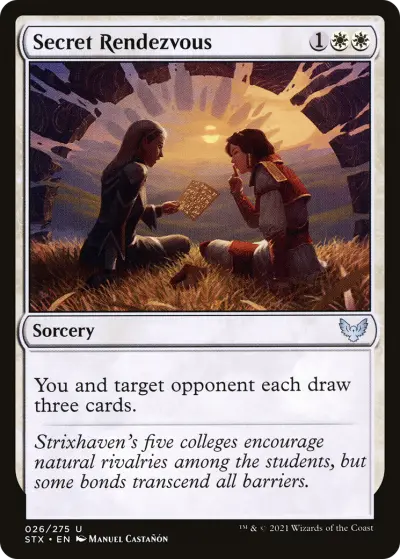
Is this card good? There are several different questions that it raises:
- Is it good to draw three cards for three mana? ...sort of? This is a bit above rate for a single shot effect, but single shot effects at three mana in Commander aren't very popular.
- Is it good for an opponent to draw three cards? Probably not. Your opponents are supplicants of a proud tradition of stopping you from doing the cool stuff you want to do. But sometimes things are dire—one opponent is a turn from going absolutely insane, and anything you can do to draw you and the rest of the board an answer is helpful for you. In this case you are sort of drawing six cards for three mana, which is nuts.
- Is it good for an opponent to draw three cards for no mana? Definitely not. In the situations where your opponent finds an answer to the problems on board, they also drew two cards for free. They will rarely use these cards to enrich your life.
The synthesis of these points is that this card is Sick (it forces you to think about a lot of different competing axes of value and flow) and Sucks (you do not want to put it in a deck.) 'Political' cards like this can be hard to play effectively, for the same reason that deals are hard—they require a deep understanding of how valuable different resources are to different players, how pressure is flowing across the game, and how good different decks are at popping off with considerable hidden information. But they never end up being hard to play, because they are so bad that they never make the deck in the first place.
Wizards has the unique opportunity to integrate these deals deeper into gameplay. What do they use this technology for?
DAWNBREAK RECLAIMER! EXPLOSION OF RICHES! I wonder sometimes if the conversations at R&D look like this:
AF: We're looking through the set and Dawnbreak Reclaimer is Five Mana.
MR: Can Commander as a format really survive a world where you can revive your opponent's best creature for five mana?
AF: Absolutely not. We can't push things that hard. Commander Future Future League testing revealed that putting this card into play with Kaalia of the Vast was so meta-warping that no other deck could thrive.
MR: Wasn't there also a gas leak in that office?
AF: Sure, but we can't take the risk. Change it to six.
So it must have gone at WotC headquarters. There have been steps towards more interesting political cards: Breena, the Demagogue is super powerful and feels great for everyone, and Noble Heritage is amazing with the right commander. But almost all of the political cards are hot garbage, which is a shame because of how much interesting and complex play could come out of them. If you are reading this, R&D: print more pushed political cards. Make us make more interesting choices.
You might object to this, as perhaps R&D does: players don't want to make deals. Well, they should; you should practice the important skills of working together with your opponents when you need to and turning them aside when you do not. Commander is just not about assembling the best engine pieces and grinding your opponents into dust. Its most iconic cards shouldn't be designed like it is. WotC clearly knows how to print pushed value engines for multiplayer and they should do it for cards like Nelly Borca too. Give players more opportunity to think hard about how the flow of pressure should go on the board, and they will be better players for it.
But Wait!
I am currently looking for both short-term and long-term work. If you're looking for someone who is good at things, have a look to see what I am good at: computer programming, writing, Magic, etc. Or if you had something else in mind, send me an email and let's see what we can do.